AI lead generation automation uses AI tools to find, qualify and nurture potential customers with far less manual work. It captures enquiries the moment they arrive, enriches contact data, scores buying intent, routes hot prospects to your sales team instantly, and runs personalised follow-up across email, SMS and voice — 24 hours a day. In the UK, every part of that system has to run inside GDPR and PECR rules, which is why the legal framework matters as much as the technology. This guide explains exactly how it works, where it adds real value, what the UK rules require, and how to choose between building it yourself, buying a tool, or hiring a managed service.
What is AI lead generation automation?
AI lead generation automation is the use of artificial intelligence to handle the repetitive stages of finding and converting new customers: identifying prospects, capturing their details, researching them, scoring their likelihood to buy, sending personalised follow-up, and booking them into your sales process. Traditional automation follows fixed if-then rules; AI automation interprets messy, unstructured inputs — a vague web enquiry, an incomplete CRM record, a reply in someone’s own words — and decides what to do next.
It’s not one tool. It’s a workflow assembled from several layers:
- Capture: web forms, chatbots, missed-call text-back, review requests and social DMs feeding one intake
- Enrichment: the system fills in missing company and contact details from legitimate data sources
- Scoring: AI ranks leads by fit and buying intent so your team calls the best first
- Routing: hot leads go to a salesperson instantly; warm ones enter nurture; unqualified ones get filtered out
- Follow-up: personalised email, SMS and voice sequences that continue until the lead converts or opts out
For a broader view of what AI automation can do across a UK business, see our AI automation guide for UK small businesses.
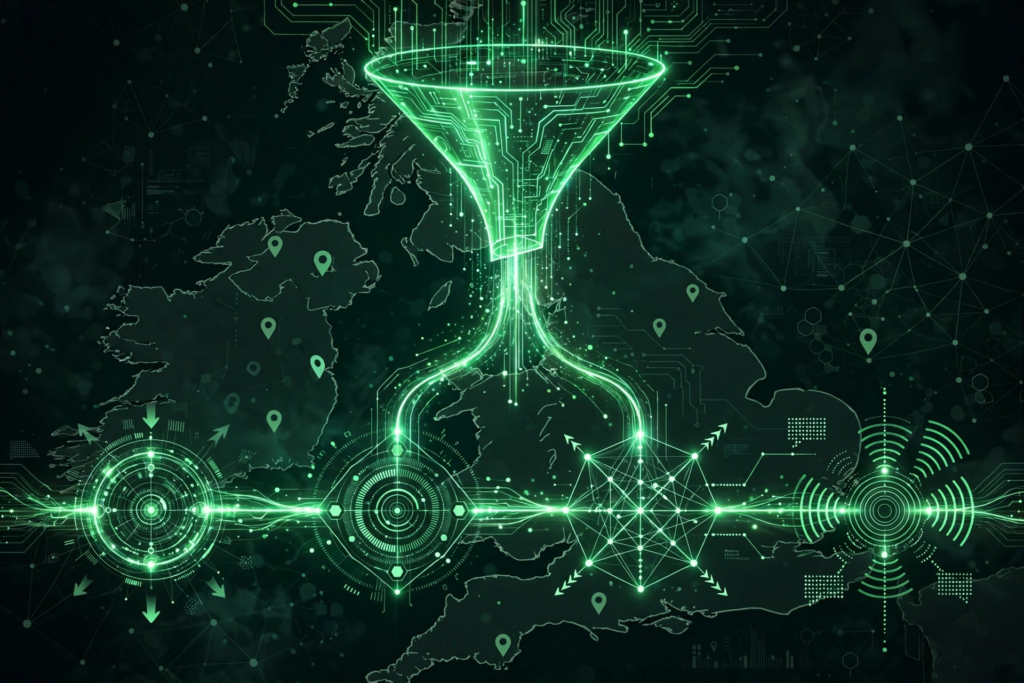
How AI lead generation automation works: the 5-stage pipeline
- 1. Capture — every enquiry lands in one place, instantly. The system watches every entry point: your website forms, live chat, missed calls, Google Business Profile messages, social media DMs and marketplace enquiries. When a lead arrives at 11pm on a Sunday, it doesn’t sit in an inbox until Monday morning — it’s captured, acknowledged and processed within seconds.
- 2. Enrich — the system fills in the gaps. AI cross-references the lead’s details against legitimate business data sources to complete the picture: company size, sector, location, role of the contact. This is where quality matters enormously — enrichment must come from lawful data sources, not scraped databases, or you’ll be building your pipeline on a GDPR liability (more on the legal rules below).
- 3. Score — AI ranks leads by likelihood to buy. Instead of your team calling leads in the order they arrived, AI scores each one on fit (do they look like your ideal customer?) and intent (are they actively shopping?). High-intent, high-fit leads get routed to a salesperson immediately; lower-priority leads go into automated nurture. Scoring models need human oversight — a model that quietly deprioritises certain postcodes or industries can create discrimination and compliance problems.
- 4. Route — the right lead reaches the right place. Routing rules send each lead where it belongs: qualified leads to the right salesperson’s calendar or phone, partnership enquiries to the director, junk and spam filtered out entirely. Done well, this is the stage that ends the “lead fell through the cracks’ problem — every enquiry has an owner and a next step within minutes.
- 5. Follow up — personalised nurture at scale. This is where AI earns its keep. The system sends personalised follow-up across email and SMS — referencing the lead’s actual enquiry, not just their first name — answers common questions, handles objections, and books meetings. Modern setups can also handle inbound calls: an AI voice agent answers, qualifies, and books the appointment while your team sleeps.
This kind of always-on pipeline is exactly what our AI automation service builds for UK businesses: capture, enrichment, scoring, routing and follow-up designed around your sales process, not a generic template.
Where AI actually adds value in the funnel
Not every part of lead generation deserves automation. Here’s where the returns are realest:
- Speed to lead. The biggest, most reliable win. A lead contacted within minutes is dramatically more likely to convert than one contacted the next day — the capture-and-route pipeline exists to eliminate the gap between “enquiry sent’ and “business responds’.
- Outbound personalisation. AI can research each prospect — recent company news, hiring signals, website changes — and write genuinely personalised outreach instead of mail-merged templates. Note the UK reality: inboxes are now full of AI-generated outreach, so buyers filter harder. Quality and relevance beat volume.
- Qualification. AI qualification agents can process high volumes of inbound leads, asking the right discovery questions and scoring answers consistently — so your salespeople only talk to prospects worth their time.
- Nurture and reactivation. Leads that weren’t ready six months ago, quotes that went cold, old CRM contacts — AI follow-up sequences work these lists continuously, surfacing buyers when their timing changes. Most businesses sit on thousands of these and never touch them.
- Data hygiene. AI keeps your CRM accurate: de-duplicating records, correcting details against external sources, logging every interaction automatically. Clean data is unglamorous and enormously valuable.
The cost bands for building these workflows are covered in our AI automation cost guide for UK agencies — and if you’re an agency looking to offer automation to clients, our AI automation agency guide covers the business model.
The UK legal rules you must follow
This is the section most guides skip — and it’s the one that can sink you. Automating lead generation in the UK is not like doing it in the US. The rules are stricter, and “the AI did it’ is not a defence. Here’s what applies:
- 1. UK GDPR treats B2B contact data as personal data. An email like name@company.co.uk identifies a person, so the full UK GDPR and Data Protection Act 2018 regime applies to your lead lists, enrichment and outreach. You need a documented lawful basis for every stage of processing.
- 2. “Legitimate interest” needs a paper trail. Most UK B2B outreach runs on legitimate interest as its lawful basis — but that requires a documented Legitimate Interest Assessment (LIA) on file before you switch the system on. It’s your main defence if the ICO investigates, and an AI agent processing thousands of contacts without one is a serious risk.
- 3. PECR restricts cold outreach. The Privacy and Electronic Communications Regulations govern unsolicited marketing: cold calling to individuals is heavily restricted, and email/SMS marketing rules depend on whether you have consent or a qualifying prior relationship. Your automation must know the difference — an AI that happily cold-calls personal mobile numbers is building you a fine, not a pipeline.
- 4. Opt-outs must be honoured instantly and permanently. Every “stop’, “unsubscribe’ or objection has to be processed immediately across all channels. Build this into the automation from day one — it is not a feature to add later.
- 5. Profiling triggers ICO rights. The ICO’s guidance is clear: individuals have the right to object to profiling, and there is an absolute right to object to profiling for direct marketing purposes — no grounds to refuse. If your AI scoring crosses into solely automated decision-making with significant effects, Article 22 of the UK GDPR adds further obligations, including the right to meaningful information about the logic involved.
- 6. The Data (Use and Access) Act 2025 adds transparency duties. In force since June 2025, the Act updated the UK’s data regime — including clearer expectations around automated decision-making transparency. If your system profiles leads to decide pricing, eligibility or priority, you need to be able to explain how it works.
- 7. Your data sources must be lawful. Scraped contact lists, bought databases of dubious provenance, and “100,000 UK business emails’ products are the fastest way to an ICO enforcement action. The ICO publishes enforcement against unlawful direct marketing — source your data from providers who can document consent or legitimate interest, or build your own lists from genuine interactions.
Relevant ICO reading: the ICO’s guidance on AI and data protection covers the legal framework for automated decision-making and profiling in detail.
What to automate vs what to keep human
The biggest mistake businesses make is automating the relationship, not just the workflow. Use this rule: automate the process, keep humans on the judgement.
| Automate | Keep human |
|---|---|
| Instant enquiry capture and acknowledgement | Final qualification of high-value deals |
| Data enrichment and CRM logging | Pricing and commercial negotiation |
| Lead scoring and prioritisation | Handling complaints and sensitive situations |
| Routine follow-up sequences (with opt-out) | Approving outreach copy and targeting criteria |
| Meeting booking and reminders | Reviewing why scored-out leads were rejected |
| Missed-call text-back and after-hours chat | Strategic decisions about which markets to target |
| Review requests after completed work (see our guide to getting more Google reviews) | Responding to negative reviews personally |
A good automation setup makes your team more human where it counts — because they’re spending their hours on conversations that need a person, not on data entry and chasing.
Build it yourself, buy a tool, or hire a managed service?
There are three honest routes, and the right one depends on your technical capacity and how much of your pipeline you’re willing to trust to a system you built yourself:
- DIY with no-code tools. Platforms like Zapier, Make and n8n connect your forms, CRM and email with AI steps in between. Cheapest in money, most expensive in your time — and the legal layer (LIAs, opt-out handling, data sourcing) is entirely your responsibility. Works for simple capture-and-notify setups; gets fragile as the workflow grows.
- Buy a lead-gen platform. Dedicated AI sales tools offer capture, enrichment, scoring and sequencing out of the box. Faster to launch, but you’re renting someone else’s workflow: data quality varies, customisation is limited, and you still own the compliance picture.
- Hire a managed AI automation service. A specialist designs the pipeline around your actual sales process, wires it into your CRM properly, and — crucially — builds the compliance layer in from the start. This is the route for businesses that want the system running correctly, not as a side project. Our AI automation service works exactly this way: we map your lead journey, build the automation around it, and quote custom to your setup — see how our pricing works (custom quotes, no fixed packages).
Agencies reading this with a different goal — offering automation to clients under your own brand — should read our AI automation agency guide and our white-label services overview, which cover the reseller models in detail.
Red flags: when lead-gen automation goes wrong
- “We have 500,000 UK business emails.“ Scraped or bought lists of mysterious origin are a GDPR time bomb. Any provider that can’t document where its data comes from is selling you liability.
- No mention of GDPR, PECR or opt-outs. If the sales pitch covers features but never compliance, the vendor hasn’t thought about the part that can fine you. Walk away.
- Black-box scoring with no explanation. If the provider can’t explain why the AI scores a lead hot or cold, you can’t defend it, fix it, or trust it. The Data (Use and Access) Act 2025 expects transparency — demand it.
- Spray-and-pray dressed up as AI. Some “AI outreach’ tools just blast more generic emails faster. Volume without relevance is spam with better branding — and it burns your domain reputation along with your brand.
- No human-in-the-loop option. Fully autonomous outreach with no approval step before messages go out is how businesses end up apologising publicly. Insist on review gates, especially early on.
- No measurement of the right things. “Leads generated’ is a vanity metric if they’re unqualified. A serious setup measures qualified meetings booked, cost per qualified lead, and show-up rates — not raw volume.
Getting started: the sensible first build
You don’t need the full five-stage pipeline on day one. The highest-ROI starting point for most UK businesses is the smallest system that fixes the biggest leak:
1. Fix speed to lead first. Instant capture, instant acknowledgement, instant routing to the right person. This alone recovers leads you’re currently losing to delay. 2. Add qualification next. A structured AI qualification step — on chat, voice or form — so your team stops spending hours on leads that were never going to buy. 3. Then layer nurture. Automated, genuinely useful follow-up for the leads that weren’t ready yet. This is where old pipelines turn into new revenue. 4. Measure qualified outcomes from the start. Booked qualified meetings, not raw lead counts. If a stage doesn’t move that number, redesign it.
The businesses seeing real returns from AI lead generation aren’t the ones with the most tools — they’re the ones that automated the right workflow and kept the legal foundations solid. Around a third of UK businesses with 10 or more employees now use AI in some form (ONS, Business Insights and Conditions Survey, June 2026), and DSIT’s 2025 research found marketing and administration among the top use cases — but the winners are the ones who picked one concrete job and did it properly.
Frequently asked questions
More general questions about working with us are answered on our FAQs page.
What is AI lead generation automation?
AI lead generation automation uses artificial intelligence to handle the repetitive stages of winning new customers: capturing enquiries, enriching contact data, scoring buying intent, routing hot prospects to your sales team, and running personalised follow-up across email, SMS and voice. Unlike fixed if-then rules, AI interprets unstructured inputs — vague enquiries, incomplete records, natural-language replies — and decides the next step.
Is AI lead generation automation legal in the UK?
Yes, when it’s built compliantly. UK GDPR applies to B2B contact data (even name@company.co.uk counts as personal data), PECR restricts cold outreach, individuals have an absolute right to object to profiling for direct marketing, and you need a documented Legitimate Interest Assessment before processing at scale. Bought or scraped lists of unknown origin are the biggest legal risk — use lawful data sources only.
What does AI lead generation automation cost?
It depends on scope. Simple DIY setups on no-code platforms cost little more than your time, while agency-built pipelines typically run into the low thousands for setup with monthly maintenance on top. Our AI automation cost guide for UK agencies breaks down the bands in detail. Spurtech itself works on custom quotes matched to your sales process — no fixed packages.
What should I automate first?
Speed to lead: instant capture, instant acknowledgement and instant routing of every enquiry. It’s the smallest build that fixes the biggest leak — leads contacted within minutes convert far better than leads contacted the next day. Add AI qualification next, then nurture sequences for leads that weren’t ready yet.
Can AI replace my sales team?
No — and it shouldn’t. AI is best at the process: capture, enrichment, scoring, routine follow-up and data hygiene. Humans should own judgement: final qualification of high-value deals, pricing, negotiation, complaints and anything sensitive. The goal is to free your team for conversations that need a person, not to remove the person.
How do I choose between building, buying or hiring a service?
Build it yourself if the workflow is simple and you have the technical time; buy a platform if you want speed and can live with someone else’s workflow; hire a managed service if you want the pipeline designed around your sales process with the compliance layer built in from day one. For UK businesses, the compliance question — GDPR, PECR, opt-outs — often decides it.