
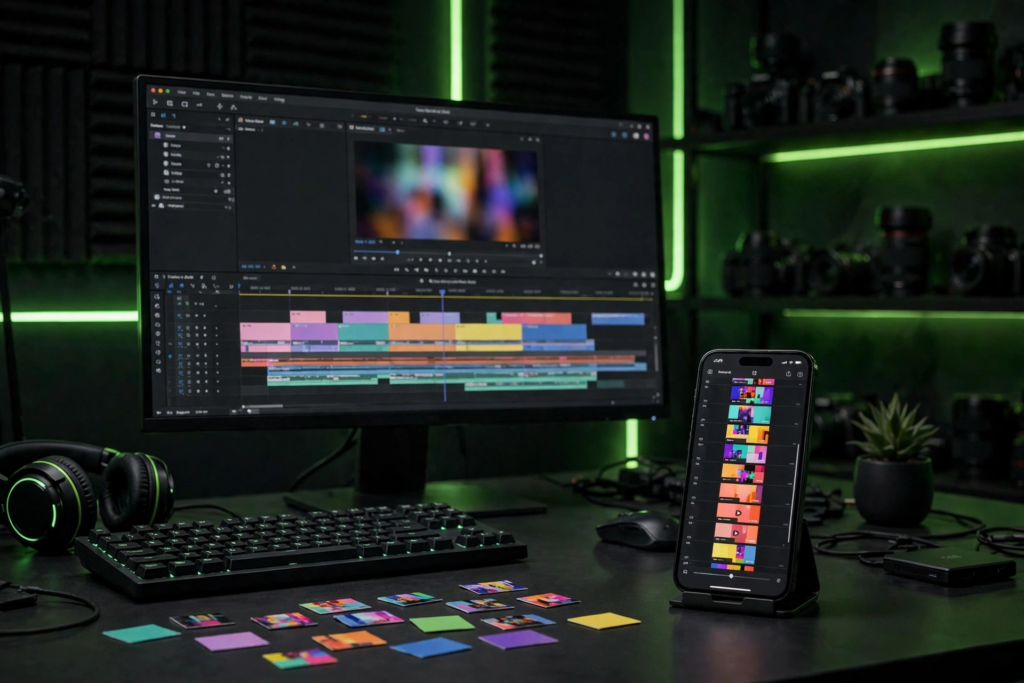
Short-form video is no longer a nice-to-have for UK businesses — it’s where your customers spend their attention. In 2026, 91% of businesses use video as a marketing tool (Wyzowl, State of Video Marketing 2026), and short-form clips on TikTok, Instagram Reels and YouTube Shorts are the most commonly used video format among marketers (HubSpot, 2025). The bottleneck isn’t filming — it’s editing. This guide shows you exactly how to evaluate short-form video editing services in the UK: the engagement models, what professional short-form craft actually includes, the vetting questions that separate good editors from risky ones, and the red flags to walk away from.
What does a short-form video editing service actually do?
A short-form editing service turns your raw footage — or your ideas — into finished vertical videos built for TikTok, Reels and Shorts. Professional short-form craft is a specific discipline, and it’s more than trimming clips:
- Hook-first editing: the first 1–3 seconds decide everything; good editors design the hook, not just the cut
- Retention pacing: fast cuts, pattern interrupts and b-roll timed to hold attention past the swipe
- Animated captions: word-by-word styled subtitles, because most of the feed watches on mute
- Trend-based audio: licensed, on-trend sound matched to your brand (never ripped audio)
- Multi-format delivery: 9:16 for TikTok/Reels/Shorts, plus 1:1 and 16:9 cutdowns where you need them
- CTA overlays and end cards: turning viewers into enquiries, not just views
Our video editing service covers all of these as standard — captions, effects, transitions, motion graphics, audio cleanup, logo animation, intro/outro design, CTA overlays, multiple aspect ratios and thumbnail design, with short-form edits typically turned around within 24 hours and revision rounds included on every project.
Why UK businesses outsource short-form editing
The numbers explain the shift. 82% of video marketers say video has given them a good ROI in 2026 (Wyzowl), and 85% say video has helped generate leads. Short-form specifically is the format marketers rate highest for ROI — 21% of marketers name it the top-performing content format (HubSpot, 2025). Meanwhile 42% of businesses already rely on external video creators in some capacity (Wyzowl, 2026) — because consistent publishing beats occasional brilliance, and consistency needs a production system, not willpower.
For UK businesses there’s a reach argument too: TikTok has 26.8 million UK users aged 18+ (DataReportal, 2025), YouTube reaches 55.5 million UK users (DataReportal Digital 2026: United Kingdom), and the average UK adult watches 51 minutes of YouTube a day (Ofcom, Media Nations 2025). Your customers are already on these platforms — the question is whether your content looks professional enough to earn their trust. 89% of consumers say video quality impacts their trust in a brand (Wyzowl, 2026).
The engagement models: which one fits your business?
Short-form editing services in the UK typically sell in one of five ways. Match the model to your publishing cadence, not just your budget:
| Model | How it works | Best for | Watch out for |
|---|---|---|---|
| Per-video / per-project | Pay per finished clip | Testing the waters, campaigns, one-off launches | Costs spike at high volume; batch discounts vary |
| Monthly subscription | Fixed monthly fee for a set number of videos (e.g. reel plans of 8–40 clips/month) | Consistent weekly publishing with predictable output | Unused videos rarely roll over; check revision limits |
| Unlimited requests | Flat monthly rate, queue-based workflow | Marketing teams with constant demand | “Unlimited” means queue-based, not instant — one active request at a time is typical |
| Bespoke retainer | Custom monthly arrangement with an editor or studio | Businesses wanting a dedicated editor who learns their brand | Needs clear scope and SLAs in writing |
| Freelancer (hourly) | Pay by the hour or day | Flexible, project-based needs | Management overhead is yours — briefing, feedback, chasing |
For detailed 2026 UK pricing across all these models — freelance hourly and day rates, per-clip costs, subscription bands — see our video editing cost guide for UK businesses, which attributes every figure to a published UK source. We don’t publish fixed prices ourselves: Spurtech works on custom quotes matched to your cadence and goals.
How to choose: the 7-point vetting checklist
Use these seven checks on any provider before you commit. A good service will answer all of them clearly; evasiveness is itself an answer.
- 1. Is their portfolio actually short-form? Many editors show wedding films and corporate work, then fumble vertical video. Ask for TikTok/Reels/Shorts samples in your niche — look for hooks, pacing and caption craft, not just colour grading.
- 2. Do they edit for retention, not just polish? Ask how they structure the first three seconds and where they expect viewers to drop off. If the answer is only about transitions and effects, they don’t understand the format.
- 3. What’s the caption and audio workflow? Animated, on-brand captions should be standard (most viewers watch muted), and music must be properly licensed — ripped trending audio is a copyright strike waiting to happen.
- 4. Can they match your brand across dozens of videos? Consistency is the hard part of short-form. Ask how they maintain style — templates, brand kits, reference libraries — across a month of output, not just one hero video.
- 5. What’s the turnaround SLA — in writing? The UK agency standard for short-form is 24–72 hours per batch. Ask what happens when they miss it, and whether rush delivery is available for time-sensitive content.
- 6. How do revisions work? Two revision rounds is the UK industry standard. “Unlimited revisions” sounds generous but often means an unstructured process; what you want is a clear review tool (like Frame.io) and timestamped feedback, not WhatsApp voice notes.
- 7. Who owns the project files? You should own the final videos outright, and ideally the project files too — so you’re never locked into one provider. Get it in writing before the first invoice.
Red flags: when to walk away
- Below-market pricing with no explanation. Quality short-form editing takes real hours; prices far under UK norms usually mean offshore subcontracting, AI-slop assembly, or both.
- No short-form portfolio. A showreel of long-form work doesn’t prove short-form craft.
- 100% payment upfront. Deposits are normal; full payment before a single frame is edited is not.
- Vague revision terms. “We’ll revise until you’re happy” without a process means endless cycles or sudden extra charges.
- No clear turnaround commitment. If they won’t put 24–72 hours in writing, they can’t staff it.
- Unclear file ownership. If the contract doesn’t say you own the finals and project files, assume you don’t.
- Unlicensed music and ripped trends. Ask directly where their audio comes from. Silence is a red flag.
What should the working relationship look like?
A professional short-form service runs a tight loop: brief → footage handoff → edit → review → deliver. You submit footage (phone clips are fine — most providers accept MP4/MOV via WeTransfer, Drive or Dropbox) with a short brief covering the hook idea, key message and CTA. The editor confirms scope, turnaround and formats before starting. You review timestamped drafts in a proper review tool, request revisions within the agreed rounds, and receive finished videos in every format you publish to. The whole cycle should feel boring and predictable — that’s the point. If you’re an agency buying editing for clients rather than for yourself, our white-label video editing guide covers the invisible-partner model built for agencies.
Freelancer vs agency vs in-house vs managed service
- Freelancer: cheapest per hour (£25–£75/hr is the UK range per published 2026 guides), maximum flexibility, but you manage briefing, feedback and availability — and good freelancers get booked up.
- Editing agency/studio: deeper bench, proper process, higher price point; best when you need volume plus creative direction.
- In-house hire: full control and brand immersion, but a UK video editor’s salary plus equipment, software and management overhead only makes sense at serious volume.
- Managed service (like Spurtech’s): a dedicated editing workflow on a custom monthly quote — the consistency of in-house without the hiring risk, and none of the freelancer juggling. Our video editing service is built exactly this way: submit footage with a brief, get finished short-form content back in 24 hours typical turnaround, revisions included.
If short-form is part of a wider paid social push, it’s worth reading our Meta ads vs Google ads comparison — creative quality is the biggest lever on ad performance, and our media buying service pairs edited creative with campaign management.
Stop letting editing be the bottleneck
Every week you post inconsistently, competitors with a proper editing workflow are taking your audience’s attention. Short-form rewards the businesses that publish relentlessly — and relentless publishing needs an editing partner, not a heroic effort. Book your free consultation today: tell us your cadence and goals, and we’ll build a custom short-form editing plan around them — custom-quoted, no fixed packages, revisions included.
Frequently asked questions
How much does short-form video editing cost in the UK?
It depends on the model: freelancers typically charge £25–£75 per hour, per-clip prices vary with batch size, and monthly reel subscriptions range from a few hundred to a few thousand pounds depending on volume. Our 2026 UK video editing cost guide breaks down every model with sourced figures. Spurtech itself works on custom quotes matched to your publishing cadence.
What’s the typical turnaround for short-form edits?
The UK agency standard is 24–72 hours per batch, with many providers — including Spurtech — turning standard short-form edits around within 24 hours. Whatever a provider promises, get the turnaround in writing along with what happens if they miss it, and check whether rush delivery is available for time-sensitive content.
Who owns the project files and final videos?
You should. A reputable service transfers full ownership of the finished videos to you, and ideally the editable project files too, so you’re never locked in. Get ownership confirmed in writing before work starts — it’s one of the most important clauses in any editing agreement.
Do I need to film the footage myself?
In most cases, yes — the popular “you shoot, we edit” model means you film on your phone and the service handles everything after. You don’t need professional equipment; good lighting, clear audio and a simple brief matter far more. Some providers also offer filming, but for short-form, authentic phone footage usually outperforms polished production.
Can one video be used on TikTok, Reels and YouTube Shorts?
Yes — that’s standard practice. A professional service delivers your edit in 9:16 for all three platforms, and can produce 1:1 or 16:9 cutdowns for Facebook, LinkedIn or YouTube main. Ask whether multi-format delivery is included in the quote or billed as an extra.
How is short-form editing different from long-form editing?
Short-form is a different discipline: hook-first structure, aggressive retention pacing, animated captions for muted viewing, trend-aware audio and vertical framing — optimised for the swipe. Long-form editing prioritises narrative, pacing over minutes, and cinematic polish. An editor who’s brilliant at one isn’t automatically good at the other, so always check their short-form portfolio specifically.